AI Is Creating a New Workforce Powering the Infrastructure Economy
Expert Advice
Mar 31, 2026





Published April 1, 2026
 By NZero

The rapid expansion of artificial intelligence and cloud computing is driving an unprecedented surge in data center development. As hyperscale operators and enterprise companies race to deploy new capacity, electricity has emerged as one of the most critical constraints. Data centers are no longer simply large energy consumers. They are becoming central actors in how power systems are planned, financed, and regulated. In this context, large load tariffs have emerged as a key mechanism shaping how data centers access and pay for electricity. While widely discussed among utilities and regulators, these tariffs remain less understood among operators and business leaders. Understanding how they work and why they are being introduced is becoming essential for managing cost, risk, and long term growth.
Large load tariffs are specialized electricity pricing structures designed for very large energy users such as hyperscale data centers, advanced manufacturing facilities, and other high demand operations. Unlike traditional tariffs that apply standardized rates across broad customer classes, large load tariffs are often customized to reflect the scale, predictability, and system impact of a specific customer.
These tariffs typically include several key components:
At their core, large load tariffs function as risk sharing mechanisms between utilities and large customers. They are designed to ensure that the costs of building and maintaining infrastructure needed to serve high demand loads are appropriately allocated.
The rise of large load tariffs is closely tied to the rapid increase in electricity demand driven by data centers and broader electrification trends. Individual data center campuses can require more than 100 megawatts of power, a level comparable to the electricity consumption of small cities. This scale of demand is placing pressure on grid infrastructure, interconnection timelines, and long term system planning.
Utilities and regulators are introducing these tariffs to ensure that the costs associated with new infrastructure are allocated more precisely and that large energy users provide greater certainty around their expected demand. This helps reduce speculative interconnection requests, supports more efficient grid planning, and limits the risk of cost shifting to other customer groups. As a result, states are taking a more active role in shaping how large loads connect to and interact with the power system.
Large load tariffs fundamentally change how electricity costs are structured for data centers. Instead of a relatively straightforward operational expense based on consumption, energy becomes a complex financial commitment with both fixed and variable components.
Key impacts include:
For data center operators, this introduces a new layer of financial risk. Overestimating demand can result in paying for unused capacity, while underestimating demand can constrain operations and limit growth. As a result, energy planning is becoming a strategic function that directly influences capital allocation and site selection decisions.
As large load tariffs become more prevalent, data center operators are required to adopt a more sophisticated approach to energy management. Accurate demand forecasting, real time monitoring, and the ability to adapt to changing conditions are no longer optional. They are critical capabilities for maintaining cost efficiency and operational flexibility.
Organizations operating data centers must now:
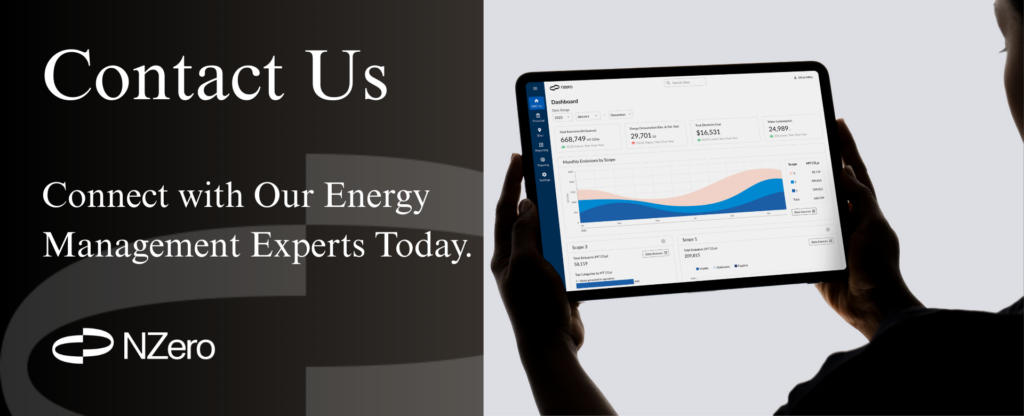
NZero works with data center customers to address these challenges by providing a unified view of energy consumption, cost, and emissions across sites. By consolidating data from multiple sources, NZero enables operators to track usage patterns with high granularity and identify opportunities for optimization.
For example, real time visibility into load profiles allows operators to better align actual usage with contracted demand levels, reducing the risk of underutilization penalties. Historical and predictive analytics support more accurate forecasting, which is critical when entering into long term tariff agreements. In addition, multi site data aggregation enables organizations to compare performance across regions and adjust deployment strategies accordingly.
NZero also supports scenario based planning, allowing data center operators to evaluate how different growth trajectories or workload distributions impact both cost and emissions. This capability becomes increasingly important as tariffs introduce more complex financial structures and as sustainability considerations continue to influence site selection and operational decisions.
By connecting energy data with financial and operational metrics, NZero helps organizations move from reactive energy management to proactive strategy. This is particularly relevant in environments shaped by large load tariffs, where small deviations in usage can have significant cost implications.
Large load tariffs are becoming a defining feature of the modern data center energy landscape. They reflect a broader shift toward greater accountability, precision, and risk sharing in how electricity systems are managed. For data center operators, these tariffs introduce new complexities but also create incentives for more efficient and data driven energy use.
As electricity demand continues to grow alongside advancements in artificial intelligence and digital infrastructure, the importance of understanding and adapting to these pricing structures will only increase. Organizations that invest in robust energy data capabilities and integrate them into strategic planning will be better positioned to manage cost, mitigate risk, and support sustainable growth.